The Silent Bookkeeping Red Flag Hiding in Your Client's Books
Aug 25, 2026138
Most red flags announce themselves. A missed payment. An angry email. A cash flow gap you can see coming from a mile away. Those are loud problems, uncomfortable, but honest.
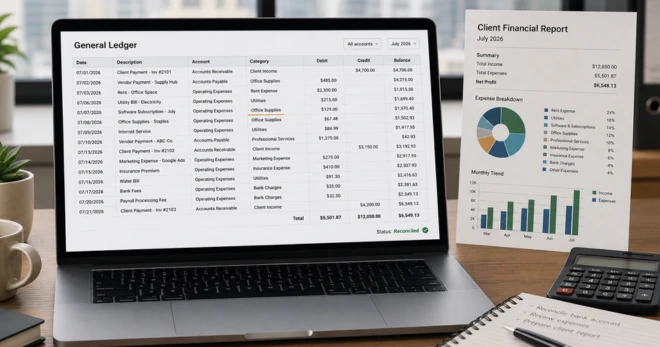
The one that actually sinks client relationships doesn't announce itself at all. It sits quietly inside books that look, on the surface, completely fine. Reconciled. Balanced. Tidy rows, tidy columns. And that's exactly what makes it dangerous, it's a red flag disguised as a clean set of books.
The Flag: Books That Balance But Don't Tell the Truth
Here's the thing accountants learn the hard way - a book can be technically balanced and still be quietly wrong. Debits match credits. The trial balance ties out. Everything reconciles on paper. But underneath that surface-level tidiness, transactions are miscategorized, recurring costs are buried under generic labels, and nobody would know unless they went line by line, month by month, asking "does this actually make sense?"
This is the silent flag: books that pass a glance-test but fail a real audit. They're not fraudulent. They're not even necessarily wrong in the technical sense. They're just imprecise in a way that quietly distorts the story the numbers are telling and by the time someone catches it, the client has usually already made a decision based on bad information. A pricing call. A budget approval. A renewal conversation. All built on numbers that looked right and weren't quite.
Why This Flag Survives So Long
It survives because nobody is incentivized to go looking for it. The client trusts that if the books balance, the books are fine. The bookkeeper assumes that if nothing's flagged an error, nothing needs fixing. And the deeper issue - vague categorization, inconsistent coding, a chart of accounts that's grown messier every quarter without anyone cleaning it up never gets addressed because it never causes a visible crisis. It just quietly erodes the accuracy of every report built on top of it.
It's the accounting equivalent of a slow leak. Nothing floods. Nothing's obviously broken. But something is always slightly off, and it compounds every reporting period until the gap between "what the books say" and "what's actually happening in the business" is wide enough that somebody important finally notices.
The Real Cost of Ignoring It
The cost isn't just financial confusion, it's trust. When a client eventually discovers that their numbers have been quietly imprecise for months, the damage isn't limited to the specific figures involved. It reframes every past report. Suddenly, the client isn't just questioning this quarter's expense breakdown, they're questioning whether anything they've been told was fully accurate. That kind of doubt is nearly impossible to walk back with an apology and a correction.
For firms managing multiple clients, this flag is even easier to miss, because attention gets split thin. One set of books gets the careful monthly review; another gets a quicker pass because "it's usually fine." That inconsistency, treating some clients' books as more deserving of scrutiny than others is often where this red flag takes root and grows undetected.
Why More Firms Are Turning to Bookkeeping Outsourcing
This is exactly the gap that bookkeeping outsourcing is built to close. A dedicated, external bookkeeping team isn't juggling the same distractions as an in-house generalist stretched across payroll, invoicing, and client calls. Bookkeeping outsourcing means every client's books get the same disciplined, line-by-line attention not because someone finally noticed something looked off, but because that scrutiny is baked into the process from day one.
Outsourced bookkeeping teams bring a second set of trained eyes to categorization, reconciliation, and reporting consistency the exact areas where silent errors like to hide. It's not about doing more work; it's about doing the same essential checks with the consistency that an overstretched internal team often can't sustain month after month.
Catching It Before the Client Does
The firms that avoid this trap aren't the ones with the most sophisticated systems - they're the ones who treat "the books balance" as the starting point for scrutiny, not the finish line. They ask harder questions of their own numbers before a client ever has to. They standardize categorization instead of leaving it to individual judgment. And increasingly, they lean on bookkeeping outsourcing to build that consistency in from the start, rather than trying to retrofit it after a client's trust has already taken a hit.
Because the real test of a bookkeeping system was never whether the numbers balance. It's whether they'd still hold up if someone looked closely.
Don't wait for your client to find the flag first. IGS Bookkeeping specializes in bookkeeping outsourcing built around precision, consistency, and audit-ready accuracy, so the silent errors get caught before they cost you a relationship. Visit IGS Bookkeeping to see how outsourced bookkeeping can keep your clients' books honest, not just balanced.
People also ask
Q1. Can books balance and still contain bookkeeping errors?
A1. Yes. Books can balance while transactions are miscategorized, recurring costs are coded inconsistently, or the chart of accounts becomes unnecessarily complex. These issues may not affect whether debits and credits match but can still distort the accuracy and usefulness of financial reports.
Q2. What is a silent bookkeeping red flag?
A2. A silent bookkeeping red flag is an issue that does not create an obvious accounting error but gradually reduces the accuracy of financial information. Examples include vague categorization, inconsistent coding, and outdated or disorganized charts of accounts.
Q3. Why can hidden bookkeeping errors affect client relationships?
A3. When clients discover that their financial information has been inaccurate or imprecise, they may begin questioning the reliability of previous reports. Even when the specific issue is corrected, rebuilding confidence can be difficult.
Q4. How can accounting firms identify hidden bookkeeping problems?
A4. Firms can look beyond whether accounts reconcile by reviewing transaction categorization, coding consistency, reporting accuracy, and whether the numbers make sense in the context of the client's business. Consistent, detailed reviews can help identify issues before they affect client decisions.
Q5. How does bookkeeping outsourcing help prevent silent bookkeeping errors?
A5. Bookkeeping outsourcing can provide dedicated professionals and standardized review processes. A consistent approach to categorization, reconciliation, and reporting can help accounting firms identify issues that an overstretched internal team may overlook.